
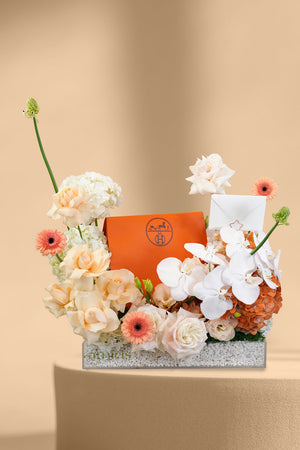
Caring for your Bespoke Tray

Keep the arrangement in cool, indirect light and away from fruit and direct draughts, which the gerbera and rose are quick to feel. The roses are heavy drinkers, so check the water level daily and top it up; the hydrangea takes in moisture through its petals as much as its stem, so a light misting helps it stay full and revived if it begins to flag. Trim the woody stems of the hydrangea and rose at a sharp angle each time you change the water, and handle the gerbera gently, as its hollow stems bend and tire more easily than the rest. Leave the orchid, ammi, and fern largely undisturbed once placed, as they hold their form well and need little beyond clean water to outlast the bouquet's earlier blooms.

A note on your specific blooms

  • Ammi — Trim stems on a sharp angle, strip any foliage below the waterline, and refresh the water often, as Ammi drinks heavily and its fine leaves cloud the water quickly.
  • Fern — Keep fronds out of direct sun and mist them occasionally, as ferns lose moisture through their leaves faster than most cut greenery.
  • Gerbera — Gerbera has fragile stems — use shallow, clean water and support the heads.
  • Hydrangea — Hydrangea takes up water through its petals — mist the heads and keep the vase topped up.
  • Orchid — Keep orchid stems in cool, clean water away from ripening fruit, whose ethylene gas makes the blooms drop early.
  • Rose — Roses drink heavily — re-cut the stems at an angle every couple of days.

How long your flowers last

Expect this mix to hold for 5–8 days overall, with the lifespan set by its most delicate elements rather than its hardiest. The hydrangea is the first to soften, often fading within 4–7 days, with the gerbera and rose close behind at 5–8 and 5–7 days respectively. Holding the longest are the orchid, which can stay fresh for two to three weeks, and the airy ammi and fern, which carry their texture for one to two weeks and quietly extend the arrangement's life as the showier blooms recede. The single most effective habit is to recut the stems at an angle and refresh the water every two days, which keeps the thirstier flowers drinking and protects the look your Amicis florist intended.

The story behind these flowers

A closer look at the blooms gathered into this arrangement.

Ammi

Origin

Nile Valley and the wider Mediterranean basin

Grown since

Known since antiquity, valued as a cut flower in modern floristry

Fragrance

All but scentless; a faint green note rises from the crushed foliage

Symbolises

Delicacy, elegance & airy lightness

A relative of the carrot, Ammi opens in wide lace-like umbels of tiny white flowers on slender stems. In an arrangement it works as a veil rather than a focal point, softening the edges around roses or peonies and lending Amicis bouquets an unstudied, garden-gathered ease.

Fern

Origin

Worldwide, in shaded woodlands and wetlands

Recorded

In the fossil record for hundreds of millions of years

Fragrance

Faint and green

Symbolises

Texture, depth & natural movement

One of the oldest plant lineages on Earth, ferns flourished long before the first flowering plant unfurled. In an arrangement their feathered, architectural fronds soften hard edges and lend a quiet woodland depth, the green foil that lets Amicis blooms read clean and considered.

Gerbera

Origin

South Africa

Described

By science in 1889

Fragrance

Barely scented, lightly fresh

Symbolises

Cheerfulness, warmth & innocence

The gerbera daisy brings open, sunlit colour and a graphic simplicity to a bouquet. Native to South Africa and loved worldwide, its clean single bloom adds brightness and a friendly, contemporary note to Amicis designs.

Hydrangea

Origin

Japan & the Americas

Cultivated since

Reached European gardens in the 1700s

Fragrance

Very light, fresh and green

Symbolises

Heartfelt emotion & gratitude

Named from the Greek for 'water vessel', the hydrangea carries full, cloud-like heads that shift colour with the soil — from blush and cream to deep blue. Its generous volume gives Amicis bouquets their soft, romantic fullness.

Orchid

Origin

Tropical regions worldwide

Cultivated since

Prized in Asia for centuries; carried to Europe across the 18th and 19th centuries

Fragrance

Most cut varieties virtually scentless

Symbolises

Refinement, luxury & rare beauty

Among the largest plant families on earth, orchids took root across the tropics of Asia and the Americas, cultivated in Asia long before reaching the West. Victorian collectors then chased them across the globe, fuelling a famous European craze. Their arched stems and sculptural blooms bring quiet architecture to an arrangement, holding their form for weeks where softer flowers fade.

Rose

Origin

Asia — China, Persia & the Mediterranean

Cultivated since

Over 5,000 years

Fragrance

Warm and sweet, of honey & tea

Symbolises

Love, gratitude & admiration

The most storied flower in the world, grown and gifted for five millennia. Its layered petals and soft scent have made it the universal language of affection — and the quiet anchor of almost every Amicis arrangement.