

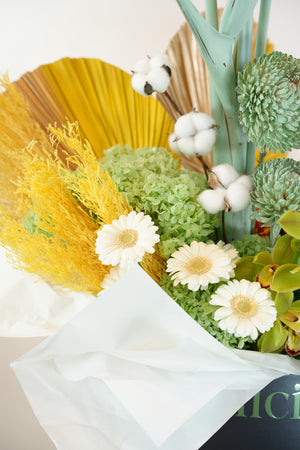
Caring for your Deco Dazzle

Keep this arrangement in a cool spot away from direct sun, draughts and ripening fruit, and give it generous clean water, as the hydrangea drinks largely through its petals and will revive from a full overnight soak if it ever wilts. The sunflower and gerbera are heavy drinkers with stems that bruise easily, so handle them gently and check the water daily to keep their faces upright. Recut the woodier chrysanthemum and orchid stems on a slant every couple of days so they take up water freely, and keep the orchid clear of the cooler so it isn't chilled. Leave the dried cotton entirely dry and lift it from the water line, and it will hold its texture long after the fresh blooms have had their moment.

A note on your specific blooms

  • Chrysanthemum — Chrysanthemum is sensitive to murky water — strip the lower leaves and refresh it often.
  • Cotton — Keep the dried bolls dry and out of humidity, which can flatten and discolour the fibre - no water is needed.
  • Gerbera — Gerbera has fragile stems — use shallow, clean water and support the heads.
  • Hydrangea — Hydrangea takes up water through its petals — mist the heads and keep the vase topped up.
  • Orchid — Keep orchid stems in cool, clean water away from ripening fruit, whose ethylene gas makes the blooms drop early.
  • Sunflower — Sunflowers are heavy drinkers, so use a tall vessel with plenty of water and top it up daily to keep the stems firm.

How long your flowers last

Expect this arrangement to hold beautifully for roughly 6–10 days, with the dried cotton bolls lasting indefinitely as a lasting structural accent. The hydrangea is the first to soften, usually fading at 4–7 days, with the gerbera close behind at 5–8, so these set the early rhythm of the bouquet. The orchid and chrysanthemum carry the display longest — the orchid often staying fresh for 2–3 weeks and the chrysanthemum for up to two — while the sunflower holds a steady middle ground. To get the most from your Amicis bouquet, recut the stems at an angle and refresh the water every two days, which keeps the thirstier blooms drinking and noticeably extends the life of the whole mix.

The story behind these flowers

A closer look at the blooms gathered into this arrangement.

Chrysanthemum

Origin

East Asia — China & Japan

Cultivated since

Over 3,000 years in China

Fragrance

Soft, earthy and herbal

Symbolises

Longevity, joy & well-wishing

One of the oldest cultivated flowers, prized in China and Japan for three thousand years and honoured with its own festival. Its dense, textured heads bring depth and a long, dependable life to an arrangement.

Cotton

Origin

Cultivated species native to the Americas; also domesticated independently in the Old World

Cultivated since

Antiquity – thousands of years

Fragrance

Virtually scentless

Symbolises

Softness, warmth & comfort

The cotton of floristry comes from species first cultivated in the Americas, where it was grown for thousands of years - though the wider genus was domesticated independently in Africa and Asia too. It arrives in an arrangement as the boll rather than the bloom, a soft burst of fibre splitting from its woody husk. Its matte, tactile white reads as quiet texture against fresh stems, lending an Amicis composition structure and an unhurried, wintry calm.

Gerbera

Origin

South Africa

Described

By science in 1889

Fragrance

Barely scented, lightly fresh

Symbolises

Cheerfulness, warmth & innocence

The gerbera daisy brings open, sunlit colour and a graphic simplicity to a bouquet. Native to South Africa and loved worldwide, its clean single bloom adds brightness and a friendly, contemporary note to Amicis designs.

Hydrangea

Origin

Japan & the Americas

Cultivated since

Reached European gardens in the 1700s

Fragrance

Very light, fresh and green

Symbolises

Heartfelt emotion & gratitude

Named from the Greek for 'water vessel', the hydrangea carries full, cloud-like heads that shift colour with the soil — from blush and cream to deep blue. Its generous volume gives Amicis bouquets their soft, romantic fullness.

Orchid

Origin

Tropical regions worldwide

Cultivated since

Prized in Asia for centuries; carried to Europe across the 18th and 19th centuries

Fragrance

Most cut varieties virtually scentless

Symbolises

Refinement, luxury & rare beauty

Among the largest plant families on earth, orchids took root across the tropics of Asia and the Americas, cultivated in Asia long before reaching the West. Victorian collectors then chased them across the globe, fuelling a famous European craze. Their arched stems and sculptural blooms bring quiet architecture to an arrangement, holding their form for weeks where softer flowers fade.

Sunflower

Origin

North America

Cultivated since

Several thousand years ago by Indigenous Americans

Fragrance

Virtually scentless

Symbolises

Adoration, warmth & loyalty

Among the oldest flowers cultivated on the continent, the sunflower was domesticated in North America several thousand years ago, grown for its seeds long before its face became a symbol of summer. Its broad golden head turns toward light, and in an arrangement it brings height, openness and an unmistakable sense of generosity.