

Caring for your Golden Prairie

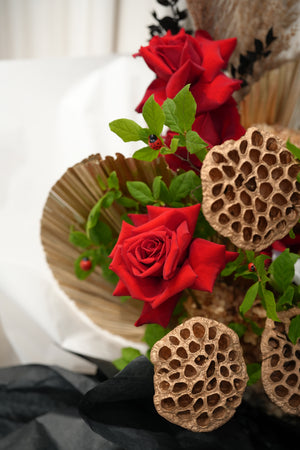
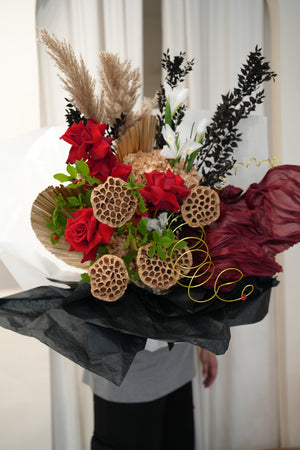
Keep Golden Prairie out of direct sun and away from cooling vents, since the hydrangea and roses are the thirstiest stems here and will wilt quickly if the water runs low. Top up and refresh the water often, and remember the hydrangea drinks through its petals as much as its stem, so a light mist or a brief upside-down soak of the head revives it when it starts to droop. Give the roses and tuberose a clean angled cut every couple of days so their stems keep drawing water freely, and strip any lower leaves that would otherwise sit below the waterline. Leave the dried lotus pods, pampas grass, palm leaf, and ruscus dry and undisturbed; they need no water and simply lend the arrangement its lasting structure long after the fresh blooms have had their moment.

A note on your specific blooms

  • Hydrangea — Hydrangea takes up water through its petals — mist the heads and keep the vase topped up.
  • Lisianthus — Its stems are slender and easily bruised, so handle gently and recut at an angle before placing in clean, shallow water.
  • Lotus Pod — Keep dried lotus pods out of damp and direct humidity, which can soften the stem and encourage mould.
  • Palm Leaf — Submerge the cut frond fully in cool water for an hour before arranging, as palm foliage rehydrates best when the whole leaf is steeped and loses moisture quickly across its broad surface.
  • Pampas Grass — Keep the plumes dry and out of humidity, and give them a gentle shake on arrival to settle and fluff the fronds.
  • Rose — Roses drink heavily — re-cut the stems at an angle every couple of days.
  • Ruscus — Strip any cladophylls that would sit below the waterline, as submerged foliage clouds the vase and shortens the life of the flowers around it.
  • Tuberose — Place tuberose away from fruit and direct heat, as both accelerate the opening and shorten the bloom's display.

How long your flowers last

Golden Prairie is a mixed arrangement, so expect a realistic display of roughly 5–7 days at its freshest, after which the fresh blooms gradually give way to the dried elements that carry on far longer. The hydrangea is the first to soften, often fading within 4–7 days, with the roses close behind at 5–7 days, while the lisianthus and tuberose tend to hold a touch longer at 7–10 days. The structural greenery is more durable still, with ruscus and palm leaf staying handsome for 2–3 weeks, and the dried lotus pods and pampas grass effectively permanent, lasting many months and well suited to keeping as a lasting accent once the fresh stems are spent. To get the most from the living flowers, change the water every two days and recut the rose and tuberose stems at an angle each time, and at Amicis we find this single habit does more than anything else to extend the bouquet.

The story behind these flowers

A closer look at the blooms gathered into this arrangement.

Hydrangea

Origin

Japan & the Americas

Cultivated since

Reached European gardens in the 1700s

Fragrance

Very light, fresh and green

Symbolises

Heartfelt emotion & gratitude

Named from the Greek for 'water vessel', the hydrangea carries full, cloud-like heads that shift colour with the soil — from blush and cream to deep blue. Its generous volume gives Amicis bouquets their soft, romantic fullness.

Lisianthus

Origin

Prairies of the southern United States and Mexico

Cultivated since

The 20th century, refined by Japanese breeders

Fragrance

Virtually scentless, clean and unobtrusive

Symbolises

Appreciation, charisma & lasting bonds

Native to the open prairies of the southern United States and Mexico, lisianthus grew wild until Japanese breeders coaxed it into the ruffled, rose-like bloom we know today. Its layered petals open in slow succession, giving an arrangement a gentle, unfurling movement long after the first stems have peaked.

Lotus Pod

Origin

Tropical Asia to Australia

Cultivated since

For thousands of years across Asia

Fragrance

Virtually scentless when dried

Symbolises

Structure, sculpture & serenity

The seed head of the sacred lotus, dried into a rigid disc of open chambers that once cradled its seeds. Long held by Asian cultures, the pod brings architectural weight and quiet negative space to an arrangement — a sculptural counterpoint that lets softer blooms read all the more clearly.

Palm Leaf

Origin

Tropical and subtropical regions worldwide

Recorded

In the ancient world, for over 2,000 years

Fragrance

Fresh and green

Symbolises

Victory, peace & endurance

Carried as a symbol of triumph and peace across the ancient Mediterranean and Near East, the palm frond has signalled honour for over two thousand years. Its long, fanned blades bring architectural line and a calm tropical green to an arrangement, framing softer blooms with quiet structure. At Amicis it is used to give height, rhythm and a sense of composed space.

Pampas Grass

Origin

Southern South America (the Pampas of Argentina, Brazil, Uruguay and Chile)

Recorded

Reached European gardens in the 1800s

Fragrance

Virtually scentless

Symbolises

Softness, height & quiet drama

Named for the South American plains it sweeps across, pampas grass earns its place through feathered, silver-blonde plumes that catch light like spun silk. As a structural accent it lends an Amicis arrangement height and movement without colour, holding its form long after fresh stems have faded.

Rose

Origin

Asia — China, Persia & the Mediterranean

Cultivated since

Over 5,000 years

Fragrance

Warm and sweet, of honey & tea

Symbolises

Love, gratitude & admiration

The most storied flower in the world, grown and gifted for five millennia. Its layered petals and soft scent have made it the universal language of affection — and the quiet anchor of almost every Amicis arrangement.

Ruscus

Origin

Mediterranean and adjacent regions, from Macaronesia east toward Iran

Described

By Linnaeus in 1753

Fragrance

Virtually unscented

Symbolises

Structure, endurance & quiet form

What read as leaves on Ruscus are flattened stems called cladophylls, which is why each glossy arch holds its shape long after softer greenery fades. In an Amicis arrangement it does the structural work - drawing the eye through a bouquet and giving roses and peonies a deep green frame to settle against.

Tuberose

Origin

Mexico

Cultivated since

Aztec times, reaching Europe in the 16th century

Fragrance

Sweet, heady and nocturnal

Symbolises

Sensuality, devotion & memory

Cultivated by the Aztecs long before Spanish ships carried it to Europe in the 16th century, tuberose went on to become one of the most prized notes in fine perfumery, its scent deepening after dark. A few stems lend an Amicis arrangement a quiet, lingering presence — the fragrance arrives before the eye does.