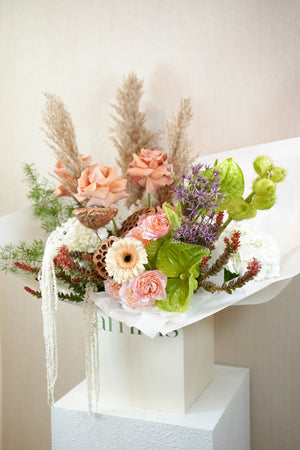
Caring for your Bijou Blossoms

This mix rewards attention to water more than anything else, since the Roses and Hydrangea are heavy drinkers and the Hydrangea takes in moisture through its petals as well as its woody stem, so a light overhead mist keeps its full heads from wilting early. Give the Roses and Hydrangea a fresh diagonal cut on their firm stems so they draw freely, and handle the more delicate Ranunculus and Gerbera gently, as their thinner, hollow stems bruise and bend easily. Keep the arrangement out of direct sun and away from cooling vents, which the Anthurium in particular dislikes. The Pampas Grass needs none of this and should simply stay dry, so lift it clear when you top up the vase.

A note on your specific blooms

  • Amaranthus — Recut the stems at an angle and keep the water shallow, as amaranthus drinks heavily and the lower stem softens quickly when submerged too deep.
  • Anthurium — Anthurium prefers warmth — keep it away from the cold and wipe the leaf gently.
  • Gerbera — Gerbera has fragile stems — use shallow, clean water and support the heads.
  • Hydrangea — Hydrangea takes up water through its petals — mist the heads and keep the vase topped up.
  • Pampas Grass — Keep the plumes dry and out of humidity, and give them a gentle shake on arrival to settle and fluff the fronds.
  • Ranunculus — Cut the hollow stems straight across, not at an angle, and keep water shallow and fresh, as these stems sit soft and bruise or rot easily when submerged too deep.
  • Rose — Roses drink heavily — re-cut the stems at an angle every couple of days.

How long your flowers last

Expect this arrangement to hold for around 5 to 8 days overall, with the dried Pampas Grass persisting far longer once the fresh blooms have passed. The Roses, Hydrangea and Gerbera are the first to soften, typically fading between 4 and 7 days, so they set the pace for the bouquet. Holding longest among the fresh stems is the sculptural Anthurium at 2 to 3 weeks, while the Amaranthus and Ranunculus sit comfortably in the 7 to 10 day range in between. The single most useful habit is to refresh the water every two days and trim each stem at an angle when you do, the simplest way to carry an Amicis bouquet through its full life.

The story behind these flowers

A closer look at the blooms gathered into this arrangement.

Amaranthus

Origin

Tropical Americas (Andes & Mesoamerica)

Cultivated since

For thousands of years by Andean & Mesoamerican peoples

Fragrance

Virtually scentless

Symbolises

Immortality, unfading love & endurance

Grown across the Americas for millennia as both grain and ornament, amaranthus is best known for its long crimson tassels that spill downward in soft, trailing ropes. Its name comes from the Greek for unfading, a nod to blooms that hold colour and form even as they dry. In an arrangement it adds movement and weight, draping over the edge of a vessel to break a clean silhouette and lend an Amicis piece an unhurried, sculptural fall.

Anthurium

Origin

Rainforests of Colombia & Ecuador

Documented

By botanists in the 1870s

Fragrance

Virtually scentless

Symbolises

Hospitality, confidence & beauty

The anthurium's glossy, sculptural 'bloom' is in fact a modified leaf, with a poised tropical architecture few flowers can match. It lends Amicis designs a clean, modern edge — and one of the longest vase lives in the bouquet.

Gerbera

Origin

South Africa

Described

By science in 1889

Fragrance

Barely scented, lightly fresh

Symbolises

Cheerfulness, warmth & innocence

The gerbera daisy brings open, sunlit colour and a graphic simplicity to a bouquet. Native to South Africa and loved worldwide, its clean single bloom adds brightness and a friendly, contemporary note to Amicis designs.

Hydrangea

Origin

Japan & the Americas

Cultivated since

Reached European gardens in the 1700s

Fragrance

Very light, fresh and green

Symbolises

Heartfelt emotion & gratitude

Named from the Greek for 'water vessel', the hydrangea carries full, cloud-like heads that shift colour with the soil — from blush and cream to deep blue. Its generous volume gives Amicis bouquets their soft, romantic fullness.

Pampas Grass

Origin

Southern South America (the Pampas of Argentina, Brazil, Uruguay and Chile)

Recorded

Reached European gardens in the 1800s

Fragrance

Virtually scentless

Symbolises

Softness, height & quiet drama

Named for the South American plains it sweeps across, pampas grass earns its place through feathered, silver-blonde plumes that catch light like spun silk. As a structural accent it lends an Amicis arrangement height and movement without colour, holding its form long after fresh stems have faded.

Ranunculus

Origin

Eastern Mediterranean and southwest Asia

Reached Europe

In the 1500s, via Ottoman gardeners

Fragrance

Faint to virtually none

Symbolises

Charm, radiance & allure

Each bloom holds dozens of tissue-thin petals layered into a near-perfect sphere, a structure that opens slowly from a tight bud into something almost rose-like. That gradual unfurling makes Ranunculus a quiet anchor in an Amicis arrangement - sculptural when closed, generous and full once it relaxes open.

Rose

Origin

Asia — China, Persia & the Mediterranean

Cultivated since

Over 5,000 years

Fragrance

Warm and sweet, of honey & tea

Symbolises

Love, gratitude & admiration

The most storied flower in the world, grown and gifted for five millennia. Its layered petals and soft scent have made it the universal language of affection — and the quiet anchor of almost every Amicis arrangement.