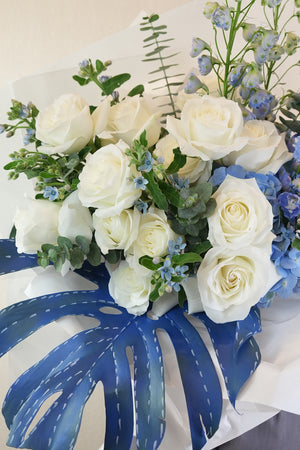
Caring for your Blue jeans

Keep the vase generously full, because the roses are thirsty drinkers and the hydrangea takes up most of its water through its petals rather than its stem alone, so a light overhead misting helps it stay turgid. The delphinium and snapdragon carry their blooms on tall, somewhat brittle stems, so give them a stable vessel and a cool spot away from direct sun and any draught. Recut every stem at a sharp angle before arranging, and split the woodier hydrangea stem slightly so it can pull water more freely. Strip any foliage that would sit below the waterline, and lift out the delphinium florets as they spend themselves to keep the rest of the arrangement clean and drinking well.

A note on your specific blooms

  • Delphinium — Keep the tall stems in deep, fresh water and out of draughts, as Delphinium drinks heavily and wilts quickly if the vase runs low.
  • Eucalyptus — Strip any lower leaves that would sit below the waterline and re-cut the woody stems on a diagonal to keep them drinking.
  • Hydrangea — Hydrangea takes up water through its petals — mist the heads and keep the vase topped up.
  • Rose — Roses drink heavily — re-cut the stems at an angle every couple of days.
  • Snapdragon — Trim the stems on a sharp angle and refresh the water often, as snapdragons drink heavily. The florets open from the bottom of the spike upward, so pinch away the lower blooms as they fade to keep the spire looking fresh.

How long your flowers last

Expect this arrangement to hold beautifully for 5–7 days, with the eucalyptus often lingering well beyond that. The delphinium and hydrangea are the first to show their age, the delphinium dropping its lower florets and the hydrangea softening within four to seven days, while the roses and snapdragons keep their form for the better part of a week. At the other end, the eucalyptus dries gracefully and can last two to three weeks, so the silhouette stays intact even as the blue tones fade. The single most useful habit is to refresh the water every two days and trim the stems on the diagonal each time you do, which keeps every Amicis stem drinking as long as possible.

The story behind these flowers

A closer look at the blooms gathered into this arrangement.

Delphinium

Origin

Native across the Northern Hemisphere, through Europe and Asia

Cultivated since

In European gardens for centuries

Fragrance

Virtually scentless

Symbolises

Openness, lightness & positivity

Named from the Greek for dolphin, after the shape of the flower itself, Delphinium carries blooms in graduated spires of cobalt, violet and white. That vertical line is what makes it indispensable in an arrangement - it draws the eye upward and gives an Amicis design its sense of height and architecture.

Eucalyptus

Origin

Australia

Described

By European botanists in the late 1700s

Fragrance

Fresh, cool and herbaceous

Symbolises

Calm, clarity & protection

Native to Australia, where it makes up the majority of the continent's tree cover, eucalyptus carries a cool, mentholic scent in its silvered leaves. As foliage it brings movement and soft structure to an arrangement, its blue-grey tones letting blooms read clearly against a quieter ground.

Hydrangea

Origin

Japan & the Americas

Cultivated since

Reached European gardens in the 1700s

Fragrance

Very light, fresh and green

Symbolises

Heartfelt emotion & gratitude

Named from the Greek for 'water vessel', the hydrangea carries full, cloud-like heads that shift colour with the soil — from blush and cream to deep blue. Its generous volume gives Amicis bouquets their soft, romantic fullness.

Rose

Origin

Asia — China, Persia & the Mediterranean

Cultivated since

Over 5,000 years

Fragrance

Warm and sweet, of honey & tea

Symbolises

Love, gratitude & admiration

The most storied flower in the world, grown and gifted for five millennia. Its layered petals and soft scent have made it the universal language of affection — and the quiet anchor of almost every Amicis arrangement.

Snapdragon

Origin

The western Mediterranean

Cultivated since

For centuries in European gardens

Fragrance

Soft and faintly sweet

Symbolises

Grace, strength & resilience

Named for the hinged bloom that opens like a dragon's mouth when pressed, the snapdragon climbs its stem in a tapering spire of colour. The florets open from the base upward, so the spire is always part open, part bud — a vertical line that gives an arrangement its height and architecture, drawing the eye upward and lending Amicis bouquets a quiet sense of movement.