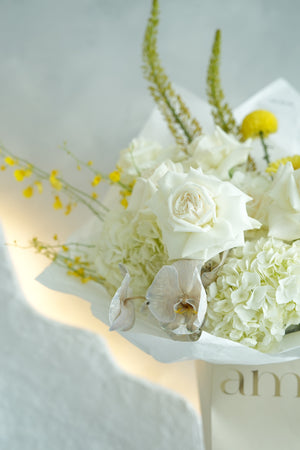
The Empress's Bouquet gathers white roses, white hydrangeas, soft yellow gerberas, spray roses and golden orchid accents into a single luminous, regal gesture. It is a study in ivory and butter yellow, where every bloom has been chosen for the way it catches light and holds its composure.
The rose needs little introduction. Cultivated for thousands of years across Persia, China and the Mediterranean, it remains the most quietly eloquent of flowers. In white, it speaks of reverence, new beginnings and sincerity, its velvety, tightly furled petals carrying that unmistakable soft, sweet fragrance. The spray roses scattered through this arrangement bring a looser, more naturalistic rhythm, opening in clusters that soften the bouquet's architecture.
Hydrangeas anchor the composition with their generous, cloud-like heads. Native to East Asia and the Americas and prized in gardens since the eighteenth century, they read as abundance and heartfelt emotion. Their papery florets give the piece volume and a gentle, full-bodied texture without ever feeling heavy. You will find more of their character across our collection of statement hydrangea arrangements.
Gerberas, members of the daisy family first recorded in South Africa, add the butter-yellow warmth that gives this bouquet its name. Open-faced and cheerful, they carry connotations of innocence and quiet joy, a counterpoint to the orchid accents threaded through the design. Orchids, long associated with refinement and rare beauty, lend their sculptural, faintly exotic line and golden tone, the detail that turns a beautiful bouquet into a regal one.
Together the palette feels luminous rather than loud: ivory for grace, gold for warmth, a composition that suits a sincere gesture of recovery, a celebration, or a centrepiece on a considered table. Explore more of this restraint among our white floral designs.
Each Empress's Bouquet is hand-finished in the Amicis Dubai atelier, arranged and wrapped by hand. To keep it at its best, trim the stems on arrival, refresh the water every couple of days, and keep the flowers out of direct sun.