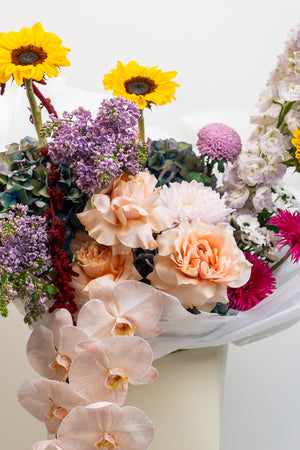
Caring for your Sunlit-Symphony

Keep Sunlit-Symphony in a clean vase with plenty of cool water, since the roses and sunflowers are heavy drinkers and will wilt quickly if the level drops below their thick stems. Hydrangeas take in moisture through their petals as much as their stems, so a light mist over the bloom heads keeps them firm and full. Re-cut the woody lilac and snapdragon stems at an angle every couple of days to keep them drawing water freely, and strip any lower leaves that would otherwise sit below the waterline and cloud it. Handle the orchid and amaranthus gently when you rearrange, as their stems are more delicate than the sturdier roses and chrysanthemums around them. Set the whole arrangement away from direct sun and any draught, and it will repay the attention.

A note on your specific blooms

  • Amaranthus — Recut the stems at an angle and keep the water shallow, as amaranthus drinks heavily and the lower stem softens quickly when submerged too deep.
  • Carnation — Cut stems cleanly between the swollen leaf joints rather than through them, as carnations draw water best when the node itself is left intact.
  • Chrysanthemum — Chrysanthemum is sensitive to murky water — strip the lower leaves and refresh it often.
  • Hydrangea — Hydrangea takes up water through its petals — mist the heads and keep the vase topped up.
  • Lilac — Lilac drinks heavily and wilts fast, so trim the woody stems on a sharp angle, strip lower leaves, and refresh the water daily.
  • Orchid — Keep orchid stems in cool, clean water away from ripening fruit, whose ethylene gas makes the blooms drop early.
  • Rose — Roses drink heavily — re-cut the stems at an angle every couple of days.
  • Snapdragon — Trim the stems on a sharp angle and refresh the water often, as snapdragons drink heavily. The florets open from the bottom of the spike upward, so pinch away the lower blooms as they fade to keep the spire looking fresh.
  • Sunflower — Sunflowers are heavy drinkers, so use a tall vessel with plenty of water and top it up daily to keep the stems firm.

How long your flowers last

Expect Sunlit-Symphony to hold beautifully for 5–7 days, with its longest-lived stems carrying on well beyond that. The hydrangea and lilac are the first to soften, typically fading at 4–7 days, so they signal when the arrangement is past its peak. At the other end, the carnations and orchids are the quiet endurers, often staying fresh for 2–3 weeks, while the sunflowers and chrysanthemums sit comfortably in between. The single most useful habit is to refresh the water every two days and trim each stem on a slant when you do — the practice Amicis relies on to keep a mixed bouquet like this looking deliberate rather than tired.

The story behind these flowers

A closer look at the blooms gathered into this arrangement.

Amaranthus

Origin

Tropical Americas (Andes & Mesoamerica)

Cultivated since

For thousands of years by Andean & Mesoamerican peoples

Fragrance

Virtually scentless

Symbolises

Immortality, unfading love & endurance

Grown across the Americas for millennia as both grain and ornament, amaranthus is best known for its long crimson tassels that spill downward in soft, trailing ropes. Its name comes from the Greek for unfading, a nod to blooms that hold colour and form even as they dry. In an arrangement it adds movement and weight, draping over the edge of a vessel to break a clean silhouette and lend an Amicis piece an unhurried, sculptural fall.

Carnation

Origin

Mediterranean region

Cultivated since

Antiquity, over 2,000 years

Fragrance

Sweet and clove-like

Symbolises

Fascination, distinction & love

Crowned in wreaths and garlands across the ancient Mediterranean, the carnation has been cultivated for more than two thousand years. Its tightly ruffled, fringed petals hold their form for weeks, lending an arrangement quiet structure and a warm, clove-edged scent that lingers without overwhelming.

Chrysanthemum

Origin

East Asia — China & Japan

Cultivated since

Over 3,000 years in China

Fragrance

Soft, earthy and herbal

Symbolises

Longevity, joy & well-wishing

One of the oldest cultivated flowers, prized in China and Japan for three thousand years and honoured with its own festival. Its dense, textured heads bring depth and a long, dependable life to an arrangement.

Hydrangea

Origin

Japan & the Americas

Cultivated since

Reached European gardens in the 1700s

Fragrance

Very light, fresh and green

Symbolises

Heartfelt emotion & gratitude

Named from the Greek for 'water vessel', the hydrangea carries full, cloud-like heads that shift colour with the soil — from blush and cream to deep blue. Its generous volume gives Amicis bouquets their soft, romantic fullness.

Lilac

Origin

The rocky hills of the southern Balkans

Cultivated since

Reached Europe in the 16th century

Fragrance

Sweet and heady

Symbolises

First love & renewal

Native to the Balkan hillsides and carried into European gardens through the Ottoman court at Constantinople in the late 16th century, lilac became the herald of late spring. Its dense panicles bring soft volume and that unmistakable perfume to an arrangement, lending an Amicis bouquet a romantic, garden-gathered ease that few flowers match.

Orchid

Origin

Tropical regions worldwide

Cultivated since

Prized in Asia for centuries; carried to Europe across the 18th and 19th centuries

Fragrance

Most cut varieties virtually scentless

Symbolises

Refinement, luxury & rare beauty

Among the largest plant families on earth, orchids took root across the tropics of Asia and the Americas, cultivated in Asia long before reaching the West. Victorian collectors then chased them across the globe, fuelling a famous European craze. Their arched stems and sculptural blooms bring quiet architecture to an arrangement, holding their form for weeks where softer flowers fade.

Rose

Origin

Asia — China, Persia & the Mediterranean

Cultivated since

Over 5,000 years

Fragrance

Warm and sweet, of honey & tea

Symbolises

Love, gratitude & admiration

The most storied flower in the world, grown and gifted for five millennia. Its layered petals and soft scent have made it the universal language of affection — and the quiet anchor of almost every Amicis arrangement.

Snapdragon

Origin

The western Mediterranean

Cultivated since

For centuries in European gardens

Fragrance

Soft and faintly sweet

Symbolises

Grace, strength & resilience

Named for the hinged bloom that opens like a dragon's mouth when pressed, the snapdragon climbs its stem in a tapering spire of colour. The florets open from the base upward, so the spire is always part open, part bud — a vertical line that gives an arrangement its height and architecture, drawing the eye upward and lending Amicis bouquets a quiet sense of movement.

Sunflower

Origin

North America

Cultivated since

Several thousand years ago by Indigenous Americans

Fragrance

Virtually scentless

Symbolises

Adoration, warmth & loyalty

Among the oldest flowers cultivated on the continent, the sunflower was domesticated in North America several thousand years ago, grown for its seeds long before its face became a symbol of summer. Its broad golden head turns toward light, and in an arrangement it brings height, openness and an unmistakable sense of generosity.