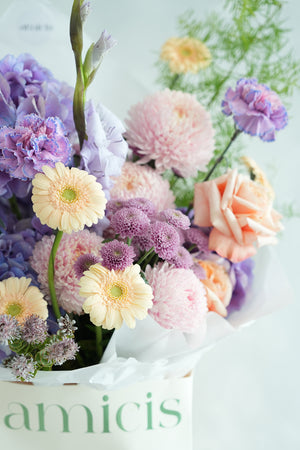
Caring for your Victorian Romance

Keep this arrangement in a cool spot out of direct sun and away from any draught or ripening fruit, since the roses and gerbera are the quickest to wilt in warmth. The roses are heavy drinkers, so check the water level daily and top it up — a half-empty vase shows on them first. Hydrangea draws moisture through its petals as much as its stem, so a light misting of the heads, or briefly submerging them if they flag, will revive them. Recut the woody gladiolus and ammi stems on a sharp diagonal so they take up water freely, and handle the snapdragon and lisianthus gently, as their stems bruise more easily than the rest. Strip any lower leaves that sit below the waterline to keep it clear and the whole mix drinking well.

A note on your specific blooms

  • Ammi — Trim stems on a sharp angle, strip any foliage below the waterline, and refresh the water often, as Ammi drinks heavily and its fine leaves cloud the water quickly.
  • Carnation — Cut stems cleanly between the swollen leaf joints rather than through them, as carnations draw water best when the node itself is left intact.
  • Chrysanthemum — Chrysanthemum is sensitive to murky water — strip the lower leaves and refresh it often.
  • Gerbera — Gerbera has fragile stems — use shallow, clean water and support the heads.
  • Gladiolus — Trim the stem and pinch off the topmost faded buds to push the remaining florets up the spike into bloom.
  • Hydrangea — Hydrangea takes up water through its petals — mist the heads and keep the vase topped up.
  • Lisianthus — Its stems are slender and easily bruised, so handle gently and recut at an angle before placing in clean, shallow water.
  • Rose — Roses drink heavily — re-cut the stems at an angle every couple of days.
  • Snapdragon — Trim the stems on a sharp angle and refresh the water often, as snapdragons drink heavily. The florets open from the bottom of the spike upward, so pinch away the lower blooms as they fade to keep the spire looking fresh.

How long your flowers last

Expect this mix to look its best for roughly 5–10 days, with the timeline set by its more delicate blooms rather than its sturdiest. The hydrangea and the roses are the first to soften — hydrangea typically holds 4–7 days and roses 5–7 — followed closely by gerbera and snapdragon at around 5–8 days. Holding longest are the carnations, which can stay fresh for two to three weeks, with lisianthus, gladiolus, ammi, and the spray of chrysanthemum carrying the arrangement through the middle of that range. The single most useful habit is to refresh the water every two days and trim a centimetre off the stems at an angle each time; at Amicis we find this small ritual does more to extend the life of a Victorian Romance than anything else.

The story behind these flowers

A closer look at the blooms gathered into this arrangement.

Ammi

Origin

Nile Valley and the wider Mediterranean basin

Grown since

Known since antiquity, valued as a cut flower in modern floristry

Fragrance

All but scentless; a faint green note rises from the crushed foliage

Symbolises

Delicacy, elegance & airy lightness

A relative of the carrot, Ammi opens in wide lace-like umbels of tiny white flowers on slender stems. In an arrangement it works as a veil rather than a focal point, softening the edges around roses or peonies and lending Amicis bouquets an unstudied, garden-gathered ease.

Carnation

Origin

Mediterranean region

Cultivated since

Antiquity, over 2,000 years

Fragrance

Sweet and clove-like

Symbolises

Fascination, distinction & love

Crowned in wreaths and garlands across the ancient Mediterranean, the carnation has been cultivated for more than two thousand years. Its tightly ruffled, fringed petals hold their form for weeks, lending an arrangement quiet structure and a warm, clove-edged scent that lingers without overwhelming.

Chrysanthemum

Origin

East Asia — China & Japan

Cultivated since

Over 3,000 years in China

Fragrance

Soft, earthy and herbal

Symbolises

Longevity, joy & well-wishing

One of the oldest cultivated flowers, prized in China and Japan for three thousand years and honoured with its own festival. Its dense, textured heads bring depth and a long, dependable life to an arrangement.

Gerbera

Origin

South Africa

Described

By science in 1889

Fragrance

Barely scented, lightly fresh

Symbolises

Cheerfulness, warmth & innocence

The gerbera daisy brings open, sunlit colour and a graphic simplicity to a bouquet. Native to South Africa and loved worldwide, its clean single bloom adds brightness and a friendly, contemporary note to Amicis designs.

Gladiolus

Origin

Southern Africa

In European gardens since

the 1700s–1800s

Fragrance

Lightly sweet to virtually scentless

Symbolises

Strength, integrity & remembrance

Named for the Latin gladius, or sword, after its tall, blade-like leaves. Each stem then stacks funnel-shaped blooms that open from the base upward, and that vertical line gives an Amicis arrangement its height and architecture, drawing the eye skyward where rounded flowers would settle flat.

Hydrangea

Origin

Japan & the Americas

Cultivated since

Reached European gardens in the 1700s

Fragrance

Very light, fresh and green

Symbolises

Heartfelt emotion & gratitude

Named from the Greek for 'water vessel', the hydrangea carries full, cloud-like heads that shift colour with the soil — from blush and cream to deep blue. Its generous volume gives Amicis bouquets their soft, romantic fullness.

Lisianthus

Origin

Prairies of the southern United States and Mexico

Cultivated since

The 20th century, refined by Japanese breeders

Fragrance

Virtually scentless, clean and unobtrusive

Symbolises

Appreciation, charisma & lasting bonds

Native to the open prairies of the southern United States and Mexico, lisianthus grew wild until Japanese breeders coaxed it into the ruffled, rose-like bloom we know today. Its layered petals open in slow succession, giving an arrangement a gentle, unfurling movement long after the first stems have peaked.

Rose

Origin

Asia — China, Persia & the Mediterranean

Cultivated since

Over 5,000 years

Fragrance

Warm and sweet, of honey & tea

Symbolises

Love, gratitude & admiration

The most storied flower in the world, grown and gifted for five millennia. Its layered petals and soft scent have made it the universal language of affection — and the quiet anchor of almost every Amicis arrangement.

Snapdragon

Origin

The western Mediterranean

Cultivated since

For centuries in European gardens

Fragrance

Soft and faintly sweet

Symbolises

Grace, strength & resilience

Named for the hinged bloom that opens like a dragon's mouth when pressed, the snapdragon climbs its stem in a tapering spire of colour. The florets open from the base upward, so the spire is always part open, part bud — a vertical line that gives an arrangement its height and architecture, drawing the eye upward and lending Amicis bouquets a quiet sense of movement.